|
An artist is part of a culture. My culture derives from the classic traditions of western civilization: the Greek Humanist heritage and the Judeo-Christian ethic. Awareness of this history is reflected in my painting. I am also a member of a mass society, informed by a media given to simplified sound bites. I combat this oversimplification with a more nuanced view.
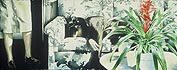
In my art, in painting what I feel compelled to paint, I am influenced by various contemporary in intellectual disciplines: natural science, psychology, philosophy: and by the art and thought of the past. I picture everything, from insects and flowers to life size portraits, to human rights violations. My portraits and still life are about observation, memory and loss. The political work is an outgrowth of my activities and a response to world events. Subject matter influences the medium I use. Egg tempera references the content in Italian Christian art, connecting human violations of the present to that of the past. Oil, with its greater plasticity and ability to portray things as they are, is more appropriate for my portraits and still-lifes. I consider myself a realist,but the word "realism" has a shifting definition, given by history and usage. My realism incorporates the classical and the ideal, the scientifically observed, and the expressive.
Cemetery Landscapes: My current work on memory and loss was prompted by an opportunity to live in Budapest, enabling me to connect to a previously unknown past. The landscapes are what remain of the old Jewish cemeteries in Eastern Europe. They lie, overgrown, behind high stone walls or barbed wire. Headstones, pushed over by saplings, are swamped in decaying brown grass and weeds. The dead lie haphazardly atop one another, layer after layer, creating an elevated hill of earth and bone.
|